

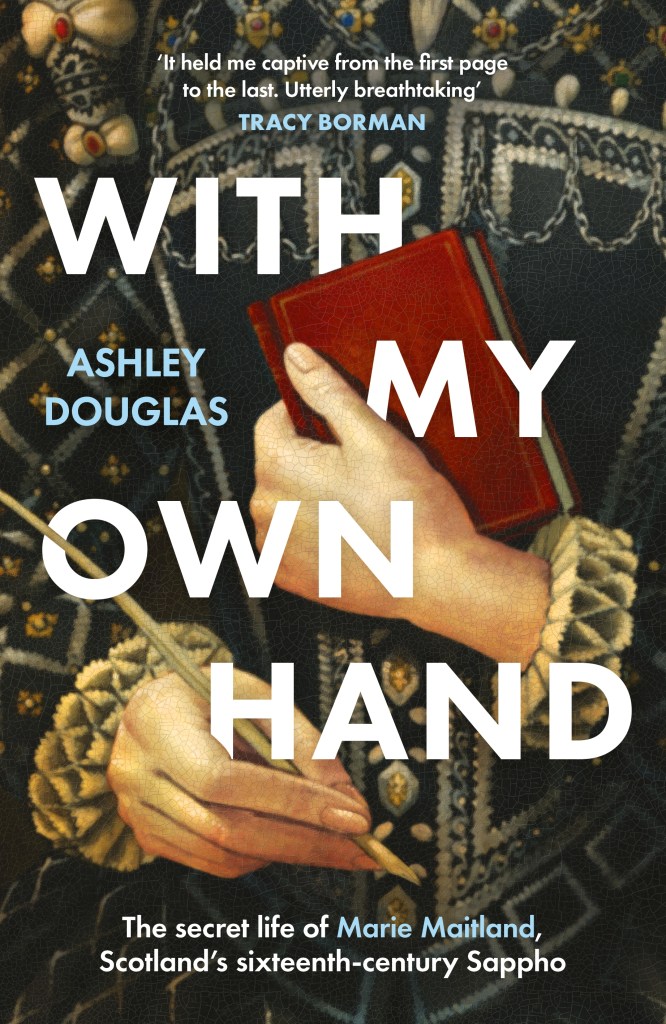
GLYPH spoke to Ashley Douglas: Scottish historian, translator and author of the recently published With My Own Hand: The Secret Life of Marie Maitland, Scotland’s Sixteenth Century Sappho.
Ashley tells us about her latest publication, her writing routine, and how to not get caught up in the all-consuming research stage of crafting a book.
Can you tell us in short, who was Marie Maitland, how did you find out about her and what compelled you
about her story?
Marie Maitland was a remarkable woman who lived in sixteenth-century Scotland at the time of the
Scottish Reformation and alongside figures such as John Knox and Mary, Queen of Scots. In this most
hostile climate, not only did Marie live a unique and meaningfully independent life as a woman, but she was
also a woman who loved other women, which we know from the powerful lesbian love poetry she left us
behind.
I first stumbled upon Marie Maitland and her poetry entirely by accident, while researching for the
National Library of Scotland’s ‘Wee Windaes’ project. When I opened the Library’s modern edition of a
sixteenth-century manuscript of Scots poetry, I was not expecting to find a woman’s name on the front
page, let alone to find lesbian love poetry inside. As a lesbian myself, I immediately recognised the
significance of Marie Maitland’s poetry and felt a strong personal connection to it. From that day on, I
made it my mission to find out everything I could about this woman and to tell her story.
As a literary mag aimed at casual writers, we’d love to hear if you had a specific writing routine for this
book?
I am very much a morning person, and so I generally always tried to write first thing in the morning, with
my first cafetière of coffee, starting around 6am! Of course, when I had big deadlines to hit, I sometimes had
to write in the evening as well – but my preference is always to write in the morning, and my advice to any aspiring writers is to work out what your best writing time is, and try to protect and write within that time as much as possible!
Research can often be an important aspect of writing, whether you’re crafting fiction or non-fiction. What
advice do you have for writers who get lost in the research stage to get out of there?
I totally understand finding it difficult to stop researching! My book tells the story of Marie Maitland for
the very first time and is based on many years of original archival research, through which I uncovered and
decoded records that had been unseen for centuries.
When I first embarked on searching for records of Marie’s life (as distinct from her manuscript of poetry), I
didn’t know how many there might be; I might have found nothing. Fortunately, however, I found loads!
One kept leading to another, and I was still identifying, and being granted access to, exciting primary
records, right up until the week I had to submit the first draft of the book to my publisher! Having a
publishing contract, and therefore a hard deadline, certainly provided a very practical form of motivation to
stop pursuing new research avenues, and focus on writing. I was also very conscious of my word limit for
the book, and knew that I had already filled it, based on what I had already found. That also helped me to,
finally, draw the line under research, and just write.
What do you hope readers, especially LGBT+ readers, will take away from Marie finally having her voice
heard?
I hope that readers take away the fact that women who love other women – women like me, like my wife,
like many of my best friends – have always been here, and that our stories are just as much a part of our
history as any others.
I hope that gay women, and LGBT+ people, in particular feel themselves validated and affirmed, and see
themselves reflected, in Marie’s story – just as she, living in the sixteenth-century, found herself and her
sapphic love reflected back at her, positively, in her classics and in her Bible.
What’s next for you in writing projects, if you can give us a little sneak peek?
Last year, I published The Lass and The Quine, which is the first ever LGBT+ inclusive children’s book in
the Scots language. In many ways, it’s a traditional fairytale – but, rather than a prince, the princess falls in
love with and gets married to another girl!
I’m very excited to say that I’m currently working on a partner book to The Lass and The Quine. Entitled
The Lad and The Loon, it is a love story between two boys, set in outer space (also featuring aliens and a
space dog!) I am co-authoring this book with the brilliant Scots writer, Shane Strachan, and it is being
illustrated by the wonderful Kate Osmond, with whom I also had the joy of working on my first children’s
book.


Leave a Reply